Showing posts with label technology. Show all posts

Saturday, January 27, 2018

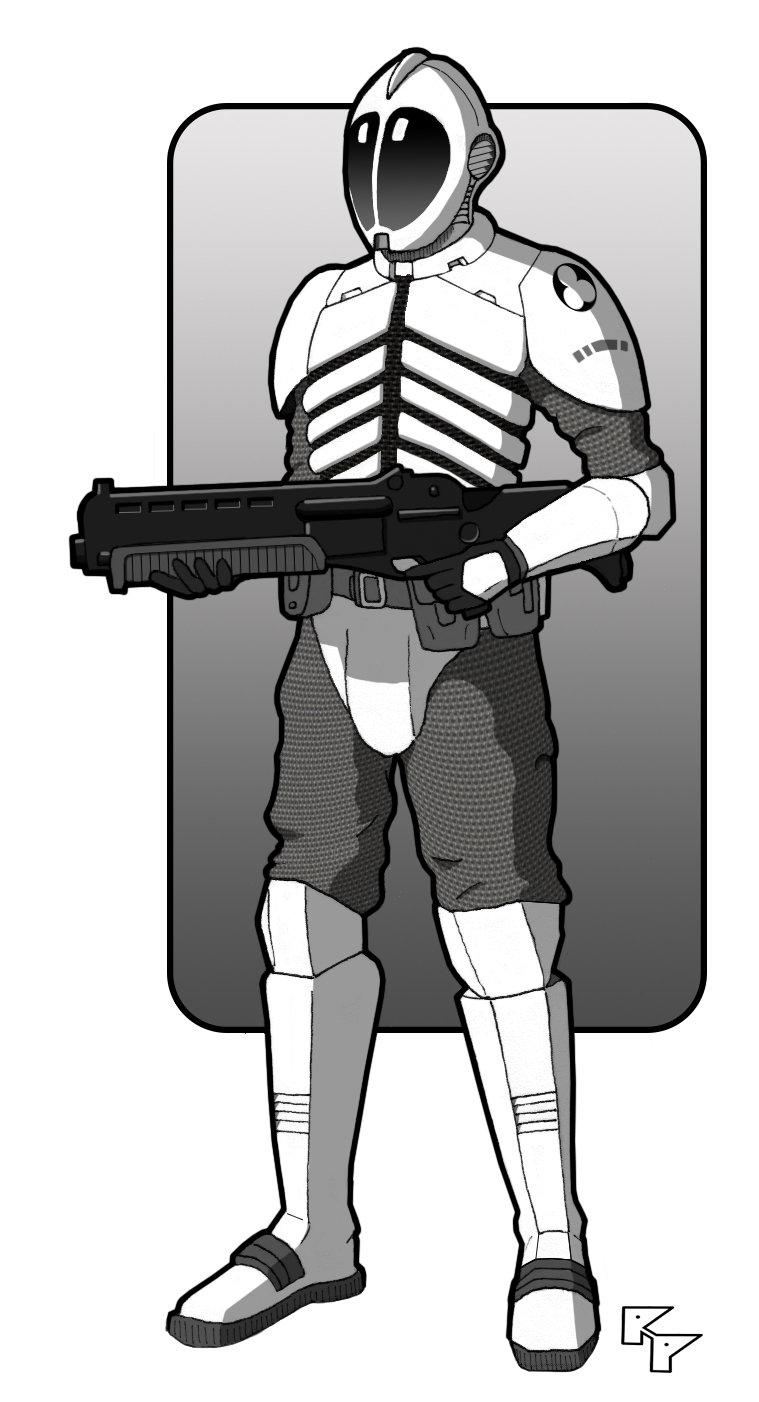
Zhodani Light Combat Armor


Essentially a stripped down version of the standard non-powered trooper armor, Zhodani light combat armor eliminates the upper arm and leg armor and utilizes a ballistic cloth body suit. The armor is not suitable for use in vacuum and sacrifices some protection for lighter weight, lower cost, and increased maneuverability. The armor can be augmented with the typical accessories and equipment. (See Alien Module 4 - Zhodani p. 16).

The armor is favored by troops who expect light combat or combat by lower tech combatants and is often the preferred armor for garrison duty and for patrolling civilian areas under occupation.

Cr16,000  TL11, Weight:  4 kg.

Thursday, September 29, 2016

W is for Warbot


"Kerpow, Kerpow!" - JON-E Warbot


Similar in size and form to the Zhodani Tliazhashal PP04 medium warbot, the Harkuna model S3S by Ikeda Robotics is designed to be quickly reconfigured in the field to serve a wide variety of mission roles. The standard combat package includes two heavy energy weapons, usually heavy lasers, PGMP-13s or FGMP-14s.

The base model includes a basic sensor package but can be upgraded with just about anything desired. For reconnaissance missions, the heavy weapons can be swapped out for a recon mission package which includes densitometers, neural activity sensors, PRIS optics, and other miscellaneous sensors.

Two retractable light arms are located in a 360 degree swivel mount in the lower torso and are capable of handling any standard human tools or weapons. Between combat operations, the heavy weapons can be replaced with heavy work arms to facilitate field base construction and supply relocation.

For spacecraft operations, the S3S is designed to be able to go just about anywhere a soldier in battledress can go. Standard doors, airlocks, vertical hatches, and elevators are all accessible to the warbot.

At TL 15, and with the proper resources, this robot can switch out its own hardware and software to meet just about any mission requirement.

Civilian use
Most worlds view a warbot much like any other weapon, and as such they are restricted by local law level. Warbots used as personal body guards are not unheard of, but such use is rare. Actions taken by a warbot are the responsibility of the owner. Stripped of it's weapons and associated programming, the standard warbot can be reconfigured for a wide variety of non-military uses.

The Adventures of JON-E Warbot
The Adventures of JON-E Warbot, was a wildly popular children's animated tri-vid series produced in the early 1090's. The show followed the exploits of a stern voiced and duty bound E-series combat robot and his skilled, but trouble prone robot technician, Clark "Skippy" Weston. Being a children's show, there was never any overt violence against humans. Many of the adventures focused on rescue and humanitarian missions. When combat operations were presented they either featured stun weapons or were against enemy robots. JON-E's famous catchphrase of "Kerpow, kerpow!" spread to all corners of the Spinward Marches.

Funded by Ikeda Robotics, the show's critics labeled it as pure propaganda and a recruitment tool for the Imperial Navy. The show's antagonists were thinly veiled Zhodani, but never called such. There is speculation that the show stirred anti-Zhodani sentiments and glorified war, at least in the eyes of impressionable children, and possibly helped to expedite the start of the Fifth Frontier War.

Fan favorite episodes include "Skippy and the Brain Pirates", "The Return of Dr. Dredzliar", and the heart-breaking "Flowers for Sargeant Goodfellow".

"I was always very proud of that show", said Galt Trydine, retired public relations executive for Ikeda Robotics. "We had actually produced a combat model very similar to JON-E, and it's capabilities were pretty faithfully represented in the show. The voders at the time were never quite able to capture the smugness of the voice actor, but I heard some fans created vocal patches that do a pretty good job of it."
-----------------------------
For additional reading about warbots, check out Classic Traveller Alien Module 4-Zhodani and Book 8 - Robots.
-----------------------------

Tuesday, September 20, 2016

P is for Personal Re-entry Pod

"I'm going to regret this." - C-3PO, Star Wars

Personal Re-entry Pods go by many names: jump capsules, drop capsules, drop pods, escape pods, Human Entry Vehicles (HEV) or HEV Pods, Orbital Insertion Pods, or for those of you not into the whole brevity thing; Single Occupant Exo-atmospheric Insertion Vehicles (SOIEV). Regardless of what they are called, they are all designed to do pretty much the same thing; get a single passenger from a ship in orbit safely to the ground.

I first remember reading about jump capsules in Robert A. Heinlein's Starship Troopers. The beginning of the book starts with a description of the "cap" (capsule) troopers making a drop from their ship to the planet below. Exciting stuff, and I was disappointed when the film version was made and it didn't include the capsule.

Generalities
The basic personal re-entry pod requires no skill to operate. Flights and landing coordinates are pre-programmed allowing the passenger to just enter the pod and activate a single, clearly marked button to launch. Historically, drop pods have a relatively high casualty rate, but improvements are always being made. The pods shown include stabilizer fins to reduce atmospheric turbulence are coated with a ablative ceramic coating to reduce heat. A small grav unit used to achieve a relatively soft landing and makes the pod usable in any atmosphere or any size world. Pods are reusable, but are unable to reach orbit on their own. The must be retrieved and re-outfitted to be used again.

Military Use
In the military, drop pods are used primarily for the insertion of ground combat troops. Drop pods can provide a benefit in combat operations by presenting multiple small targets as opposed to one big one, and also by strategically placing troops in specific locations. Flights are pre-programmed in at a console in the drop bay, and the actual launch is initiated by an officer who remains on the ship. The typical one man pod is a tight fit for a soldier with gear, and special interiors have been created for those wearing battledress. The military also use a non-occupied version of the drop pod, which replaces the passenger compartment with a storage compartment for pinpoint delivery of weapons, food, and supplies.

Non-military Use

A drop pod's primary non-military use is as a spaceship's emergency escape vehicle. Escape vehicles designed for 8, 12, or 16 passengers are more the norm, and much more economical. Still, if you have a small ship, or when you want to get off a ship fast and don't want to wait for other passengers, the single occupant pod is the way to go. The pod's launch sequence is tied directly into the ship's navigation computer, which automatically computes the safest trajectory and landing zone. This information is updated automatically by the ship's computer every five minutes, although the pilot or navigator can select different coordinates if desired. Non-military models typically contain an emergency vacc suit, emergency rations and supplies, and an automated tracking beacon.

Check out Twilight of the GM's excellent article "Abandon Ship", for more thoughts about escape pods.

Also take a look at Atomic Rockets well thought article on the folly of escape pods in the article "Emergency Deck".


Below is a Drop Capsule geomorph, with a similar Pod Bay. It includes areas for the cap troops and a control center, from where the capsules are programmed and launched. In this scenario, even the sleeping quarters are pods - kind of like the Japanese capsule hotels. Maybe cap troopers are agoraphobes.

Saturday, September 17, 2016

N is for Non-lethal Weapons


"Who but a puppeteer would go around with a weapon that does good to the enemy?" - Louis Wu, Ringworld

The Traveller universe is a dangerous place. Whether it's claws, blades, modern slugthrowers, or high tech energy weapons, it really doesn't take to much to neutralize the average Traveller character.

Early in my gaming career, when I finally got the grasp of combat and had a character with a decent sub-machine gun skill, I kind of went in "rampage mode" for a while. I'd kill with abandon, often occasionally upsetting the referee's game plan by shooting an enemy NPC rather than sneaking around him or talking to him. The SMG was my hammer and every problem I came across was a nail. Brian, our wise referee and gaming mentor, finally took me aside and told me that combat was a two-way street. If I continued to shoot everything that moved, the enemy might decide to take the same approach to my character. "Don't kill all the guards, and maybe they'll show you the same courtesy if they catch you." In a game where it's easy to die, I was given the advice to take a different approach and live a little longer. It was good advice, and opened the door to much more varied gaming experience. It wasn't long before my characters were using diplomacy, bribery, carousing, and DEX rolls (stealth) to achieve their goals without firing a round.

I think it was Star Frontiers that introduced me to the tangler gun, and about that time my younger brother, who worked for the police department, bought his first taser. The two events got me thinking about non-lethal weaponry and how they could be used in Traveller. Over the years I incorporated a few non-lethal weapons into my games, but never really formalized anything. Aside from a basic "to hit" mechanic, non-lethal weapons are more about effect, and less about damage, with an occasional "saving throw" option to keep it interesting.

There are a wide variety of real world, non-lethal weapons you can incorporate into your games, and they can be found at every tech level. A quick note about nomenclature: I realize that some people prefer the term "less lethal" for weapons of this nature and I understand why. When I hear in the news of those few occasions where a police officer tases a suspect and the suspect dies, I can't help think that either the officer rolled a natural 12  to hit or the suspect rolled a 2 on his END save. Role playing games have, in some ways, given me a very distorted view of the world. Regardless, for the sake of this discussion I am sticking with the term "non-lethal".

Types of Non-lethal Weapons
Non-lethal weapons may have one or more of the following effects:
  • Immobilize/Incapacitate - keeps the target from moving or taking action
  • Render unconscious/sleep - self explanatory
  • Cause pain - acts as a deterrent, but causes little pain, maybe 1 or 2 points of damage
  • Inconvenience - may not actually affect the target, but creates a barrier for him to accomplish his goals

Real world non-lethal weapons and possible gaming effects

  • Blow dart, tranquilizer gun - effect varies on the toxin used, target may get an option to roll END or less on 2d6 to avoid the effects, ineffective against many types of armor
  • Pepper spray, tear gas grenade - temporary blindness, target at -2 on all actions
  • Immobilizing weapons such as a thrown net, bola, lasso, or net gun - immobilizes the target, DEX roll to avoid, STR roll next round to escape
  • Electroshock weapons (Tasers, stun guns, etc.) - deliver an electric charge which causes neuromuscular incapacitation
  • Non-lethal ammunition (rubber bullets, bean bags, rubber shrapnel grenades, etc.) - similar to standard slugthrowers, but with decreased damage
  • Smoke grenades, flashbang (stun) grenade - temporary blindness but no physical damage - good for stealth maneuvers and distractions
  • Attack animals such as police dogs or trained predatory birds - differ from standard animal attacks in that the animal is trained to minimize damage.

Real world weapons in development but not widely used include:
  • Heat Ray (ADS) or Active Denial System - The Active Denial System is a dish that projects electromagnetic radiation just powerful enough to penetrate human skin and make the nervous system think the victim is on fire although no physical damage is done. (from Wikipedia) "Suddenly your whole body has been turned into a giant radio receiver and the only station it gets is PainFM."
  • The Long Range Acoustic Device (LRAD) is an acoustic hailing device that sends messages and warning tones over longer distances or at higher volume than normal loudspeakers. LRAD systems are used for long range communications in a variety of applications including as a means of non-lethal, non-kinetic crowd control. Though they have been called "sonic weapons", LRADs are not inherently for military use. (from Wikipedia)
  • LED Incapacitator -  It works by emitting bright, rapid pulses of light. It temporarily blinds and disorientates the subject, who will suffer intracranial pressure as a result of being exposed to the LED incapacitator. This can cause cluster headaches, nausea and vomiting.
  • Dazzler - A dazzler is a directed-energy weapon intended to temporarily blind or disorient its target with intense directed radiation. Targets can include sensors or human vision. Dazzlers emit infrared or invisible light against various electronic sensors, and visible light against humans, when they are intended to cause no long-term damage to eyes.
  • The SpeechJammer - while not technically a weapon, it is used against loud targets to shut them up.
  • The PHASR - temporarily blinds the target
  • Chemical malodorants - stink bombs, effectively. Really, really bad stink bombs.
  • Pheromone Weapons - (file this under Truth is Stranger than Fiction) The "halitosis bomb" and "gay bomb" are informal names for two theoretical non-lethal chemical weapons that a United States Air Force research laboratory speculated about producing; the theories involve discharging female sex pheromones over enemy forces in order to make them sexually attracted to each other. (from Wikipedia). Maybe there is a seed of a decent Traveller weapon in there, who knows?
  • The Thunder Generator - designed for crowd dispersal, sends a powerful shock wave at the target, knocking them down.
  • Sticky Foam Gun - emits a stream of expanding, sticky foam, incapacitating the target

Non-lethal Weapons in Science Fiction
  • "Sick Stick" (Minority Report, Kick-Ass 2) - Baton that induces vomiting on contact. "Designed for crowd control but deemed too severe. It emits a pulse that creates spontaneous nausea and diarrhea."
  • Kronos Goo Balls (The Incredibles) - cannons shoot balls of black goo that stick to whatever they hit and expand on contact.
  • Tangler technology (pistol, rifle, grenades) - shoots a physical web or chemical agent that produces strong "threads" upon release), used to immobilize targets.
  • The Tasp (Ringworld) - The tasp, a device that remotely stimulates the pleasure center of the brain; it temporarily incapacitates its target and is extremely addictive. If the subject cannot, for whatever reason, get access to the device, intense depression can result, often to the point of madness or suicide. To use a tasp on someone from hiding, relieving them of their anger or depression, is called "making their day".
  • Electroshock weapons - Electrostaff (Star Wars) or Stun Pike (Tron)
  • Sonic Weapons - Geonosian sonic blaster (Star Wars), sonic shotgun (Minority Report)
  • Gravity grenade - creates a temporary gravity well, pulling anything not nailed down within a twenty foot radius towards it.

Non-lethal  Weapons and Vehicles
There are also weapons that can be used against vehicles that generally will not harm the occupant:
  • Spike strips - do damage to vehicle tires only
  • EMP devices - Electromagnetic pulse shuts down a vehicle's electronics. At higher tech levels this is a directed pulse, so that it only shuts down what it hits.

Non-lethal Weapons and the Law
Not all non-lethal weapons are legal or considered ethical. The use of blinding weapons (permanent eye damage) and many chemical weapons will be deemed unethical, even though they don't kill.

Many of these weapons might have multiple uses. One of my personal favorites, and standard equipment IMTU is the expanding foam grenade. When detonated near a human target it covers the person in a foam that expands to render them immobile. They can be used in starships to block corridors, or tossed in a vehicle cockpit to quickly make the vehicle unusable. As a last ditch effort it can be used to patch small hull breaches.


Enjoy, and let's be careful out there!


Sunday, September 11, 2016

I is for Interdiction

"Warning: Trespassers will be shot. Survivors will be shot again." - unknown

One of my minor frustrations with the Traveller sector generation process was the creation of Amber and Red Zone worlds. I loved that they were included in the process, but there was no way to determine why the planet had a restricted classification. I've created the table below to address the reason for and enforcement of planetary interdiction.

IMTU the reason for the restriction is usually, but not always, made public and can be determined by contacting the local TAS office, Imperial Navy public liaison, or checking with a trusted news source. Amber Zones are not usually interdicted, but Red Zones almost always are. Note that the official reason a planet has been interdicted is not always the real reason.

Travel Zone & Interdiction   (A for Amber Zone, R for Red Zone)

A1    general chaos
A2    societal upheaval
A3    local xenophobia
A4    government coup
A5    piracy
A6    oppressive government
A7    oppressive laws
A8    dangerous society
A9    minor war
   
R1    wildlife refuge
R2    protect developing society
R3    wealthy family's private reserve
R4    to protect valuable resources
R5    protect sensitive installation
R6    punishment of local government
R7    quarantine a disease
R8    trade embargo
R9    world war
RA    global disaster
RB    Ancient site
RC    protect military base
RD    military or arms embargo
RE    known psionic community
RF    classified

Interdiction Classification and Enforcement
Class and Actions Taken
0: No travel restrictions, not interdicted
1: Automated satellite - Broadcasts restrictions, and collects transponder data of ships entering in range of system
2: Automated satellite - Will open fire on ships entering the restricted zone
3: Automated or manned satellite- Will open fire on ships entering the restricted zone
4: Interdiction Station (400 ton) - Will open fire on ships entering the restricted zone
5: Close Escort (300 ton)- Will intercept ships and escort them away or fire upon them if necessary
6: System Defense Boat (400 ton) - Will intercept ships and escort them away or fire upon them if necessary

The class and quantity of enforcement units goes up with the Navy's assessment, but there are usually 3 to 4 units per system.

An example of a Class 2 satellite is the InSat-12, shown below.
An example of a Class 3 satellite is the 300 ton Type SMU-4C/D from GW's IISS Ship Files.
An example of a Class 4 Interdiction Station can be found in Space Gamer magazine (#67).
An example of a Class 5 Close Escort can be found in Supplement 7 - Traders and Gunboats.
An example of a Class 6 System Defense Boat can be found in Supplement 7 - Traders and Gunboats.

For the purposes of this article, interdiction refers to the prohibition of access to a world from the outside. It does not inherently prevent anything leaving the planet. Interdiction differs from a blockade, which is intended to prohibit any ships from entering or exiting a world. The typical interdicted zone is a sphere of 100 planetary diameters, although this often varies, especially for smaller worlds. The Imperial Navy views penetrating the 100 diameter sphere as indicating clear intent of planetary interaction as it is the cut-off point for safe jumps.

Weapons Platforms and Spy Satellites
The design of an interdiction satellite is not too much different from the design of an orbital weapons platform, interdiction satellites just tend to announce their intentions first. Some satellites are fitted with a wide variety of sensors, so that the conditions on the planet may be monitored.

The InSat-12 Automated Interdiction Satellite
The InSat-12 is a twelve ton, Class 2 automated interdiction satellite used by the Imperial Navy. It is fairly standard for its class, which typically range from 10 to 40 dtons. This satellite is produced at TL14 and uses a L-Hyd fueled power plant. Older models and some produced at earlier tech levels still use a generator and solar collection panels for power. It can maneuver at 1G, which allows for orbital relocation, system patrols, and basic combat maneuvers. It is armed with a double pulse laser turret and a multiple sensors.



Thursday, September 8, 2016

H is for Hydroponics (and Food Production Technology)

"Soylent Green is people!" - Detective Frank Thorn

This post is a little bit of a cop-out. I intended to do this post on Hydroponics. After all, it starts with an 'H', it's practically a sci-fi trope equivalent to space food, and I had already drawn a Hydroponics Bay geomorph. Easy peasy, right?

But the truth is, I really don't know much about hydroponics. Or the future of food production. Or the past of food production.

Food for Thought
But luckily, I loves me some Google and have an affinity for all things Traveller. I looked to see what I could find in the published material and online forums and came up with surprisingly little. My research notes slowly turned into a Tech Level table, that frankly, I'm having a hard time completing. I figured Traveller Grognards are a pretty smart group in general, so I humbly throw my incomplete work at your feet. Tear it to shreds, fellas. Look into your crystal balls and let me know what you think about food in the far future.

I've still included the Hydroponics Bay geomorph, but suspect it will need revision after I've heard from others.

 Technology Levels and Food Production (click image to see larger version)
In the future, only the emotionally unstable eat real meat, just ask any K'Kree (from Star Wars #31)