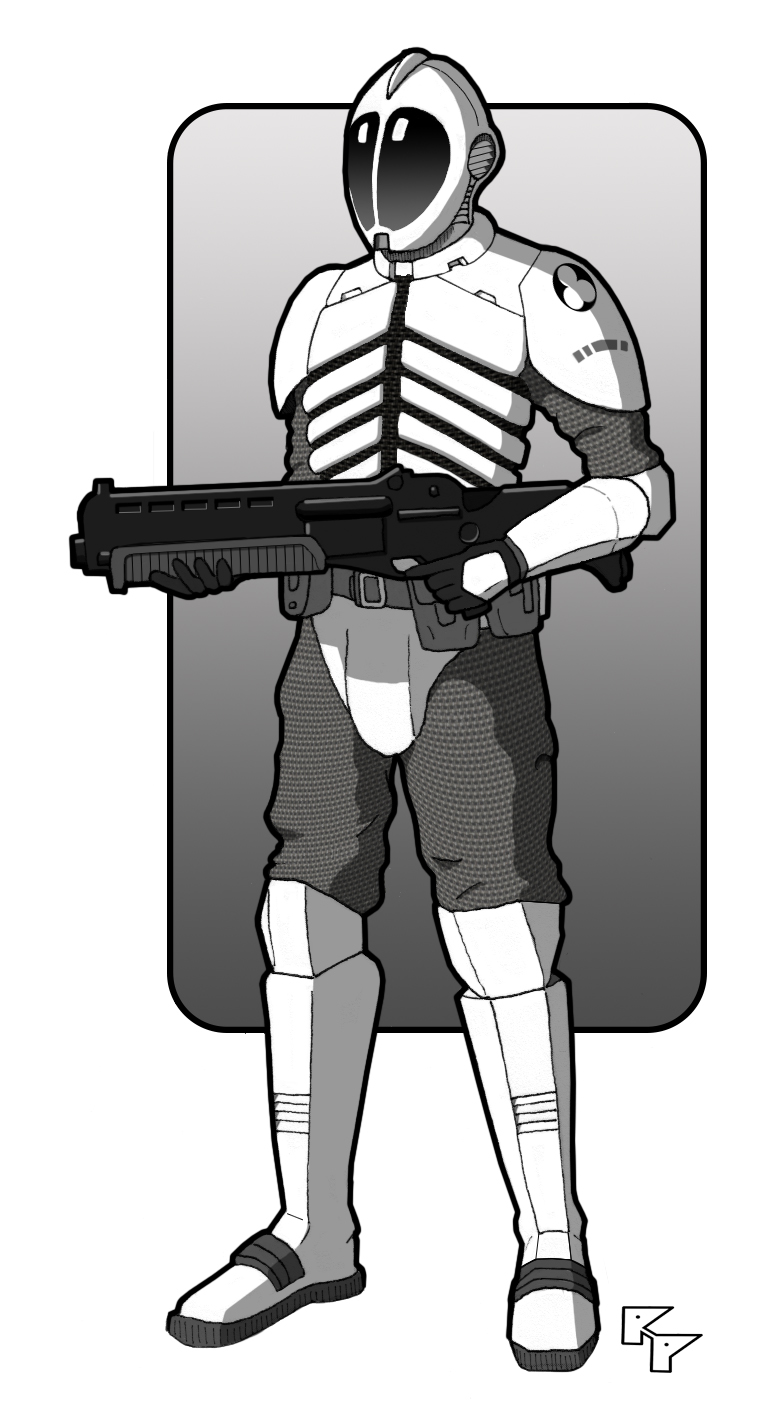
"Who but a puppeteer would go around with a weapon that does good to the enemy?" - Louis Wu, Ringworld
The Traveller universe is a dangerous place. Whether it's claws, blades, modern slugthrowers, or high tech energy weapons, it really doesn't take to much to neutralize the average Traveller character.
Early in my gaming career, when I finally got the grasp of combat and had a character with a decent sub-machine gun skill, I kind of went in "rampage mode" for a while. I'd kill with abandon, often occasionally upsetting the referee's game plan by shooting an enemy NPC rather than sneaking around him or talking to him. The SMG was my hammer and every problem I came across was a nail. Brian, our wise referee and gaming mentor, finally took me aside and told me that combat was a two-way street. If I continued to shoot everything that moved, the enemy might decide to take the same approach to my character.
"Don't kill all the guards, and maybe they'll show you the same courtesy if they catch you." In a game where it's easy to die, I was given the advice to take a different approach and live a little longer. It was good advice, and opened the door to much more varied gaming experience. It wasn't long before my characters were using diplomacy, bribery, carousing, and DEX rolls (stealth) to achieve their goals without firing a round.
I think it was
Star Frontiers that introduced me to the tangler gun, and about that time my younger brother, who worked for the police department, bought his first taser. The two events got me thinking about non-lethal weaponry and how they could be used in Traveller. Over the years I incorporated a few non-lethal weapons into my games, but never really formalized anything. Aside from a basic "to hit" mechanic, non-lethal weapons are more about effect, and less about damage, with an occasional "saving throw" option to keep it interesting.
There are a wide variety of real world, non-lethal weapons you can incorporate into your games, and they can be found at every tech level. A quick note about nomenclature: I realize that some people prefer the term "less lethal" for weapons of this nature and I understand why. When I hear in the news of those few occasions where a police officer tases a suspect and the suspect dies, I can't help think that either the officer rolled a natural 12 to hit or the suspect rolled a 2 on his END save. Role playing games have, in some ways, given me a very distorted view of the world. Regardless, for the sake of this discussion I am sticking with the term "non-lethal".
Types of Non-lethal Weapons
Non-lethal weapons may have one or more of the following effects:
- Immobilize/Incapacitate - keeps the target from moving or taking action
- Render unconscious/sleep - self explanatory
- Cause pain - acts as a deterrent, but causes little pain, maybe 1 or 2 points of damage
- Inconvenience - may not actually affect the target, but creates a barrier for him to accomplish his goals
Real world non-lethal weapons and possible gaming effects
- Blow dart, tranquilizer gun - effect varies on the toxin used, target may get an option to roll END or less on 2d6 to avoid the effects, ineffective against many types of armor
- Pepper spray, tear gas grenade - temporary blindness, target at -2 on all actions
- Immobilizing weapons such as a thrown net, bola, lasso, or net gun - immobilizes the target, DEX roll to avoid, STR roll next round to escape
- Electroshock weapons (Tasers, stun guns, etc.) - deliver an electric charge which causes neuromuscular incapacitation
- Non-lethal ammunition (rubber bullets, bean bags, rubber shrapnel grenades, etc.) - similar to standard slugthrowers, but with decreased damage
- Smoke grenades, flashbang (stun) grenade - temporary blindness but no physical damage - good for stealth maneuvers and distractions
- Attack animals such as police dogs or trained predatory birds - differ from standard animal attacks in that the animal is trained to minimize damage.
Real world weapons in development but not widely used include:
- Heat Ray (ADS) or Active Denial System - The Active Denial System is a dish that projects electromagnetic radiation just powerful enough to penetrate human skin and make the nervous system think the victim is on fire although no physical damage is done. (from Wikipedia) "Suddenly your whole body has been turned into a giant radio receiver and the only station it gets is PainFM."
- The Long Range Acoustic Device (LRAD) is an acoustic hailing device that sends messages and warning tones over longer distances or at higher volume than normal loudspeakers. LRAD systems are used for long range communications in a variety of applications including as a means of non-lethal, non-kinetic crowd control. Though they have been called "sonic weapons", LRADs are not inherently for military use. (from Wikipedia)
- LED Incapacitator - It works by emitting bright, rapid pulses of light. It temporarily blinds and disorientates the subject, who will suffer intracranial pressure as a result of being exposed to the LED incapacitator. This can cause cluster headaches, nausea and vomiting.
- Dazzler - A dazzler is a directed-energy weapon intended to temporarily blind or disorient its target with intense directed radiation. Targets can include sensors or human vision. Dazzlers emit infrared or invisible light against various electronic sensors, and visible light against humans, when they are intended to cause no long-term damage to eyes.
- The SpeechJammer - while not technically a weapon, it is used against loud targets to shut them up.
- The PHASR - temporarily blinds the target
- Chemical malodorants - stink bombs, effectively. Really, really bad stink bombs.
- Pheromone Weapons - (file this under Truth is Stranger than Fiction) The "halitosis bomb" and "gay bomb" are informal names for two theoretical non-lethal chemical weapons that a United States Air Force research laboratory speculated about producing; the theories involve discharging female sex pheromones over enemy forces in order to make them sexually attracted to each other. (from Wikipedia). Maybe there is a seed of a decent Traveller weapon in there, who knows?
- The Thunder Generator - designed for crowd dispersal, sends a powerful shock wave at the target, knocking them down.
- Sticky Foam Gun - emits a stream of expanding, sticky foam, incapacitating the target
Non-lethal Weapons in Science Fiction
- "Sick Stick" (Minority Report, Kick-Ass 2) - Baton that induces vomiting on contact. "Designed for crowd control but deemed too severe. It emits a pulse that creates spontaneous nausea and diarrhea."
- Kronos Goo Balls (The Incredibles) - cannons shoot balls of black goo that stick to whatever they hit and expand on contact.
- Tangler technology (pistol, rifle, grenades) - shoots a physical web or chemical agent that produces strong "threads" upon release), used to immobilize targets.
- The Tasp (Ringworld) - The tasp, a device that remotely stimulates the pleasure center of the brain; it temporarily incapacitates its target and is extremely addictive. If the subject cannot, for whatever reason, get access to the device, intense depression can result, often to the point of madness or suicide. To use a tasp on someone from hiding, relieving them of their anger or depression, is called "making their day".
- Electroshock weapons - Electrostaff (Star Wars) or Stun Pike (Tron)
- Sonic Weapons - Geonosian sonic blaster (Star Wars), sonic shotgun (Minority Report)
- Gravity grenade - creates a temporary gravity well, pulling anything not nailed down within a twenty foot radius towards it.
Non-lethal Weapons and Vehicles
There are also weapons that can be used against vehicles that generally will not harm the occupant:
- Spike strips - do damage to vehicle tires only
- EMP devices - Electromagnetic pulse shuts down a vehicle's electronics. At higher tech levels this is a directed pulse, so that it only shuts down what it hits.
Non-lethal Weapons and the Law
Not all non-lethal weapons are legal or considered ethical. The use of blinding weapons (permanent eye damage) and many chemical weapons will be deemed unethical, even though they don't kill.
Many of these weapons might have multiple uses. One of my personal favorites, and standard equipment IMTU is the expanding foam grenade. When detonated near a human target it covers the person in a foam that expands to render them immobile. They can be used in starships to block corridors, or tossed in a vehicle cockpit to quickly make the vehicle unusable. As a last ditch effort it can be used to patch small hull breaches.
Enjoy, and let's be careful out there!