Showing posts with label ship's locker. Show all posts
Saturday, January 27, 2018
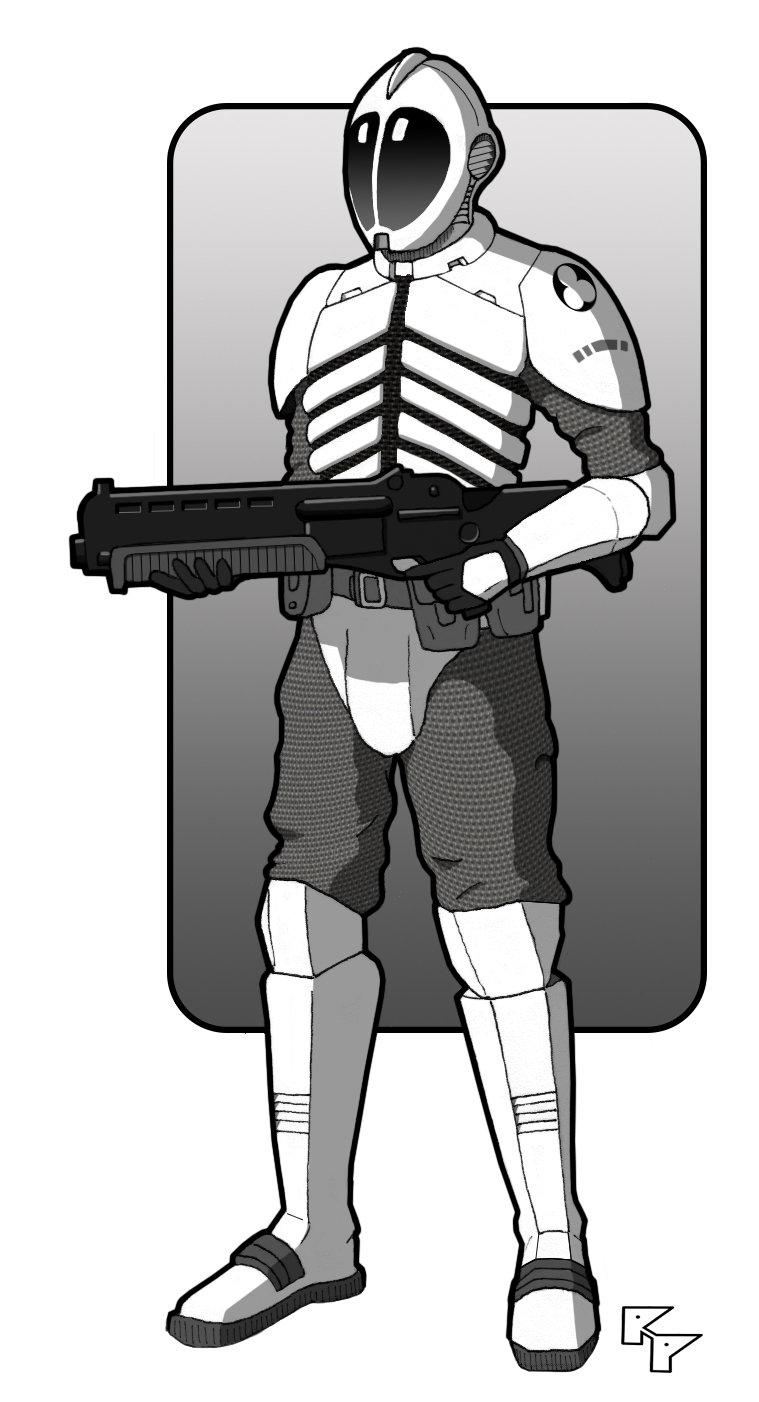
Zhodani Light Combat Armor
Essentially a stripped down version of the standard non-powered trooper armor, Zhodani light combat armor eliminates the upper arm and leg armor and utilizes a ballistic cloth body suit. The armor is not suitable for use in vacuum and sacrifices some protection for lighter weight, lower cost, and increased maneuverability. The armor can be augmented with the typical accessories and equipment. (See Alien Module 4 - Zhodani p. 16).
The armor is favored by troops who expect light combat or combat by lower tech combatants and is often the preferred armor for garrison duty and for patrolling civilian areas under occupation.
Cr16,000 TL11, Weight: 4 kg.
Wednesday, January 17, 2018
Better Living Through Chemistry: Drugs in Traveller
When time is available, I run a solo exploration campaign past the edge of Imperial space. Since the crew won't necessarily have a dependable source of health care, the corporation funding the expedition has arranged to supply the ship's medic with a plethora of drugs; some legal, some not, some tried and true, and some experimental. The ship's medic was given a cursory training on the effects and side effects of each drug. Drugs are in a variety of forms (pills, liquid, injection,
inhalant, etc.)
This isn't meant as any in-depth review of use of pharmaceuticals in a Traveller game, more just rough notes for my campaign.
Also check out Wikipedia's entry: List of Fictional Medicines and Drugs
-----------------------------------------------------------------------------------------------
Vaccines - standard inoculations that may the ship's medic may require crew members have before visiting a planet, or that the planet may require of new visitors
Anti-toxins - a variety of generic drugs to combat flora and fauna which may scratch and bite
Antibiotics – decrease severity of illness and
increase healing
Metabolics – effective against a wide range of
diseases (rare, expensive, high tech)
Slow Drug - So named because it makes the
universe (from the user’s viewpoint) appear to move more slowly, the drug
achieves the effect by accelerating the user’s metabolism. In effect, the user
lives approximately twice as fast as normal. Slow drug takes effect 45 seconds
after ingestion and continues to function for about 10 minutes. At the end of
its effect the person is extremely fatigued and must recover from that fatigue.
A person under slow drug (because he or she is living at twice the normal rate)
can make twice as many actions or move twice as far as normal.
Medical Slow Drug - A medical slow drug is also
available, which is used to hasten recovery from wounds or illness. One dose
causes unconsciousness and the passage of thirty days equivalent recovery time
in one day. During this period, ordinary healing takes place. No wounds are
received from the use of medical slow drug, but the individual is unconscious
or semi-conscious while under its influence.
Fast Drug - So named because it makes the
universe (to its user) appear to move much more quickly, the drug slows down
personal metabolism at a ratio of approximately 60 to 1. Users are extremely
vulnerable while living at such a slow rate, but physical aging is also slowed,
and the need for consumable supplies is reduced which thus allows conservation
of air and food. Fast drug takes effect immediately upon ingestion. One dose
lasts for 60 days, making that time appear to be only one day. An antidote is
available to end the effect before 60 days. Fast Drug (TL9 - 2,000 Cr), Fast
Antidote (TL-12 - 900 Cr)
Combat Drug - Taken by fighters (usually
military personnel) prior to combat, this drug increases personal strength and
endurance. The effect begins 30 seconds after being taken and lasts for about
10 minutes.
Anagathics - Anagathics or Antiagathics are
longevity drugs, usually a mixture several compounds. They help prolong life
and prevent aging in Humans. A regimen of regular monthly doses enables an
individual to ignore the debilitating effects of advancing years. They need to
be used starting at the age of 30, and with luck, the user may reach an age of
100 or more before old age affects the user. Because of the rarity and demand
for anagathics, they are quite expensive and are often unavailable at any
price. It takes a while for the total effects of anagathics to be felt; it also
takes a while for the effects of anagathics to totally go away. However there
are withdrawal effects from interrupting the supply of anagathics. Obviously,
anagathics are most effective if they can be taken long-term without
interruption. A continually interrupted supply can have devastating effects.
Anagathics have dangerous side-effects on some users and often anagathics users
take extra risks to maintain a constant supply. Society generally frowns on
nobles who take anagathics.
Truth Drug - Drug used to compel individuals to
answer interrogation truthfully, one dose is sufficient to assure truthful
answers for approximately two minutes, after which the user experiences one
hour of unconsciousness, then becomes groggy and unresponsive for several
hours.
PSI Drugs - Chemical means are available to
enhance a person's Psionic Strength on a temporary basis. Because the general
public attitude towards psionics is negative, psi drugs are expensive and are
extremely difficult to obtain. These drugs are as follows:
Booster - The basic psi-drug, booster is
available in small one-dose pills. Booster increases an individual’s available
psionic strength by about half (for average strength psis) if taken when
psionic strength is at full power, or by a third if psionic strength is at a
reduced level. Additional doses of booster have no effect if taken by a psionic
within an hour. The drug-induced additional psionic strength will wane and
disappear at the end of one hour.
Double - A more potent form of the drug, also
available in small one-dose pills. Otherwise identical to booster, double
increases psionic power by about double (for average strength psis) if taken
when psionic strength is at full power, or by two-thirds if taken when psionic
strength is at a reduced level.
Special - The rarest of psi-drugs, special is
available only in liquid form and must be taken by injection. Special gradually
increases psionic strength points to 15, at the rate of one point per hour.
Psionic strength remains at this level (if unused) for four hours, and then
wanes at the rate of one point per hour until psionic strength reaches zero.
Normal recovery then occurs. Special has some dangers and may permanently
reduce Psi strength.
Non-canon drugs:
Pep drug - a special stimulant available in
pill form which holds back all need for food or sleep for 12 hours. The user
feels rested and alert, and all of his reactions are as normal. Pep also has
the ability to negate the effects of damage—the user will not fall unconscious
when a characteristic is reduced to zero; he can continue to fight after his
endurance is used up; he will act in all respects as if no damage was taken.
Once the Pep wears off all damage effects will return, and the user will take
an additional 1D damage.
Sleep Drug - A tasteless water-soluble pill,
sleep drug puts its user into a deep dreamless sleep that lasts for 12 hours.
nothing will wake the user during that time. Sleep drug takes 10 seconds per
point of the user's endurance to take effect (i.e.: someone with END 7 will
take 70 seconds to succumb.) TL5, Cr 20 per dose.
Sober Drug - These pills will immediately
cancel out the effects of alcohol or narcotics, making the user sober. It is
quite useful in the event of combat after a hard night's drinking. TL8: Cr2 per
dose, usually in boxes of 10.
Knowledge Drug - not actually a single drug but
a dose of RNA and a nootropic drug combination that can teach the user new
skills and knowledge. Each injection can be used to teach one specific skill
level, or 3 injections can be used to increase the user's education by one.
Education cannot be increased above 15, and the total skill level limit of
intelligence plus education still applies. Knowledge drug injections must be
administered into the Cerebrospinal fluid by someone with medical skill to take
proper effect. After the drug is taken the user enters a state similar to
catatonia, during which his mind assimilates the data. The player must then
roll his intelligence or lower on 2D to leave this state after 2D days.
Otherwise he remains catatonic permanently.
Byphodine - A drug which can induce a state of
reduced metabolic function. Unexamined, a person under the effects of Byphodine
is easily mistaken for a cadaver (Firefly).
Interfectum - Painkillers that take the place
of first-aid kits, capable of keeping a man alive and able to function even
after numerous gunshot wounds. (Max Payne)
Lethe - Powerful drug developed to blank (or
possibly just interfere with) memory so rejuvenation patients do not remember
feeling pain or other problems associated with the treatments. Lethe
("forgetfulness") induces total amnesia. The subject loses all
memories of everything that happened before the dose was administered. The base
duration for this memory loss is 4 weeks. At the end of this period, the
subject makes a roll against INT-2 each week to shake off the effects. On a
successful roll, the subject's "lost" memories come flooding back. On
a critical failure, the memory loss has become permanent; the character is
considered to have acquired the Total Amnesia disadvantage, and can only buy it
off with character points. (GURPS)
Oblivio - (Latin for "forgetfulness")
is chemically very different from Lethe, and induces temporary retrograde
amnesia. For each dose – to a maximum of four doses – the drug temporarily
wipes out 3d6 weeks of the subject's memory record, starting at the moment the
drug was administered and counting backwards. Thus, if the subject is given
three doses, he forgets everything that happened in the 9d6 weeks before the
drug was administered. The drug also renders the subject instantly unconscious
for 10d6 minutes.
The
drug has a base duration of 1d+6 days. After that period, every day the subject
attempts to roll INT-2 or less on 2d6. If he succeeds, and his memory comes
back immediately, although in most cases he will never recall the period one
hour before the drug was administered. On a natural roll of 2, however, he does
remember that one-hour "window." On a natural roll of 12, the
temporary amnesia becomes permanent.
The
maximum number of doses that can be administered at one time – safely – is
four. A fifth dose requires the subject to make a INT-4 roll or become comatose
for 20-INT hours, and suffer 3d damage plus 1d of additional damage for each
dose after the fifth.
Agents
will sometimes want to maintain this kind of temporary amnesia beyond the base
duration. This requires multiple administrations of Oblivio. Each time the
subject receives the drug, the GM must secretly roll the base duration for that
particular administration (i.e., 1d+6). The number of doses he received in that
batch is considered to be still in effect for that time. If he receives more
doses before that time is up, to bring the total number of "active
doses" up to 5, the subject will suffer the effects of an
"overdose" as described above. (GURPS)
Medi-Gel - A compound mixture of anti-toxins,
blood-clotting agents and restorative chemicals that enable a quickened healing
process. A cheap, easily applied solution used in civilian and military life.
(Mass Effect)
Stim pack - regenerates 1d6+1 health points
immediately (TL12, Cr 2,000 per dose). Additional doses have no effect until
one week has passed
Triox - used to enrich the body in oxygen for
use in environment poor in oxygen. (Star Trek). Variants of this drug may be used on planets with thin and dense atmospheres in lieu of breathing apparatus. Tainted atmospheres will still require a filter of some sort.
Brilliance - An illicit drug (contraband) which
acts as an intelligence enhancer. (Privateer)
Ephemerol - Psionic suppression drug (Scanners)
Buffout - A green tablet that boosts user's
physical attributes. Addictive if taken excessively.(Fallout)
HERC (increased STR)
---------------------------------------------------------------------------
Drug Delivery Systems
Drugs may be
delivered by any of the following methods (unless indicated otherwise above)
- Oral pill (easiest and most common)
- Oral liquid
- Inhaler (oral or nasal)
- Syringe or "hypospray" Injection (best location to be determined - arm, gut, etc.)
- Skin contact "patch", or sub-dermal patch requiring a medical procedure (may be active from the time of insertion or activated by the user at any time or run continuously from the time of insertion (a sub-dermal "button" that could say, increase the user's adrenaline could come in handy).
- Suppository
- PC: "We've captured the terrorist and want to use a truth serum to get him to talk."
- GM (rolls dice): "Okay, but the only truth drug you have available is in suppository form."
- PC: "We'll waterboard him instead."
- Cream applied to skin
- Medicine dropper (onto the tongue, nose, or eyes)
- Device attached to the user that needs to regulate drug injection, such as an armband with a reservoir of drug and a small pump.
- A piece of equipment, such as the Half Life HEV suit, which will automatically inject drugs into the system when it detects a certain level of damage. This same concept could be incorporated into armor, armband, inhaler mask, or similar pieces of worn gear.
- For more flavor, maybe a biological agent must be used, such as a drug-secreting leech or other non-traditional creatures (Ceti Alpha V eel, Babel Fish, Trill symbiont, etc.). Maybe the leech has to be injected with the drug, and it is then attached to the patient. The drug only works once it has been metabolized by the creature and passed on to its host.
- Instead of some pharmaceutical, maybe it is a piece of technology that is inserted or applied to stimulate the body's own chemical production (this starts to get into cyber-gear territory) - Check GURPS Cyber for more ideas.
Additional thoughts:
- Determine the optimum time for the drug to take effect (a strength enhancing drug may not be worthwhile if you are facing an immediate threat and it takes an hour to take effect.
- Determine drug effect duration and any possible side effects, addictiveness, etc.
- Does the drug need to be prepared any special way prior to use, such as brought up to a certain temperature, or mixed with other compounds?
- How is the drug stored? Pill bottle, liquid bottle (glass, plastic, metal), inhaler cartridge, hypospray cartridge, in its raw form (such as a leaf or root that must be chewed), etc.
Thursday, September 29, 2016
W is for Warbot
"Kerpow, Kerpow!" - JON-E Warbot
Similar in size and form to the Zhodani Tliazhashal PP04 medium warbot, the Harkuna model S3S by Ikeda Robotics is designed to be quickly reconfigured in the field to serve a wide variety of mission roles. The standard combat package includes two heavy energy weapons, usually heavy lasers, PGMP-13s or FGMP-14s.
The base model includes a basic sensor package but can be upgraded with just about anything desired. For reconnaissance missions, the heavy weapons can be swapped out for a recon mission package which includes densitometers, neural activity sensors, PRIS optics, and other miscellaneous sensors.
Two retractable light arms are located in a 360 degree swivel mount in the lower torso and are capable of handling any standard human tools or weapons. Between combat operations, the heavy weapons can be replaced with heavy work arms to facilitate field base construction and supply relocation.
For spacecraft operations, the S3S is designed to be able to go just about anywhere a soldier in battledress can go. Standard doors, airlocks, vertical hatches, and elevators are all accessible to the warbot.
At TL 15, and with the proper resources, this robot can switch out its own hardware and software to meet just about any mission requirement.
Civilian use
Most worlds view a warbot much like any other weapon, and as such they are restricted by local law level. Warbots used as personal body guards are not unheard of, but such use is rare. Actions taken by a warbot are the responsibility of the owner. Stripped of it's weapons and associated programming, the standard warbot can be reconfigured for a wide variety of non-military uses.
The Adventures of JON-E Warbot
The Adventures of JON-E Warbot, was a wildly popular children's animated tri-vid series produced in the early 1090's. The show followed the exploits of a stern voiced and duty bound E-series combat robot and his skilled, but trouble prone robot technician, Clark "Skippy" Weston. Being a children's show, there was never any overt violence against humans. Many of the adventures focused on rescue and humanitarian missions. When combat operations were presented they either featured stun weapons or were against enemy robots. JON-E's famous catchphrase of "Kerpow, kerpow!" spread to all corners of the Spinward Marches.
Funded by Ikeda Robotics, the show's critics labeled it as pure propaganda and a recruitment tool for the Imperial Navy. The show's antagonists were thinly veiled Zhodani, but never called such. There is speculation that the show stirred anti-Zhodani sentiments and glorified war, at least in the eyes of impressionable children, and possibly helped to expedite the start of the Fifth Frontier War.
Fan favorite episodes include "Skippy and the Brain Pirates", "The Return of Dr. Dredzliar", and the heart-breaking "Flowers for Sargeant Goodfellow".
"I was always very proud of that show", said Galt Trydine, retired public relations executive for Ikeda Robotics. "We had actually produced a combat model very similar to JON-E, and it's capabilities were pretty faithfully represented in the show. The voders at the time were never quite able to capture the smugness of the voice actor, but I heard some fans created vocal patches that do a pretty good job of it."
-----------------------------
For additional reading about warbots, check out Classic Traveller Alien Module 4-Zhodani and Book 8 - Robots.
-----------------------------
Saturday, September 17, 2016
N is for Non-lethal Weapons
"Who but a puppeteer would go around with a weapon that does good to the enemy?" - Louis Wu, Ringworld
The Traveller universe is a dangerous place. Whether it's claws, blades, modern slugthrowers, or high tech energy weapons, it really doesn't take to much to neutralize the average Traveller character.
Early in my gaming career, when I finally got the grasp of combat and had a character with a decent sub-machine gun skill, I kind of went in "rampage mode" for a while. I'd kill with abandon, often occasionally upsetting the referee's game plan by shooting an enemy NPC rather than sneaking around him or talking to him. The SMG was my hammer and every problem I came across was a nail. Brian, our wise referee and gaming mentor, finally took me aside and told me that combat was a two-way street. If I continued to shoot everything that moved, the enemy might decide to take the same approach to my character. "Don't kill all the guards, and maybe they'll show you the same courtesy if they catch you." In a game where it's easy to die, I was given the advice to take a different approach and live a little longer. It was good advice, and opened the door to much more varied gaming experience. It wasn't long before my characters were using diplomacy, bribery, carousing, and DEX rolls (stealth) to achieve their goals without firing a round.
I think it was Star Frontiers that introduced me to the tangler gun, and about that time my younger brother, who worked for the police department, bought his first taser. The two events got me thinking about non-lethal weaponry and how they could be used in Traveller. Over the years I incorporated a few non-lethal weapons into my games, but never really formalized anything. Aside from a basic "to hit" mechanic, non-lethal weapons are more about effect, and less about damage, with an occasional "saving throw" option to keep it interesting.
There are a wide variety of real world, non-lethal weapons you can incorporate into your games, and they can be found at every tech level. A quick note about nomenclature: I realize that some people prefer the term "less lethal" for weapons of this nature and I understand why. When I hear in the news of those few occasions where a police officer tases a suspect and the suspect dies, I can't help think that either the officer rolled a natural 12 to hit or the suspect rolled a 2 on his END save. Role playing games have, in some ways, given me a very distorted view of the world. Regardless, for the sake of this discussion I am sticking with the term "non-lethal".
Types of Non-lethal Weapons
Non-lethal weapons may have one or more of the following effects:
- Immobilize/Incapacitate - keeps the target from moving or taking action
- Render unconscious/sleep - self explanatory
- Cause pain - acts as a deterrent, but causes little pain, maybe 1 or 2 points of damage
- Inconvenience - may not actually affect the target, but creates a barrier for him to accomplish his goals
Real world non-lethal weapons and possible gaming effects
- Blow dart, tranquilizer gun - effect varies on the toxin used, target may get an option to roll END or less on 2d6 to avoid the effects, ineffective against many types of armor
- Pepper spray, tear gas grenade - temporary blindness, target at -2 on all actions
- Immobilizing weapons such as a thrown net, bola, lasso, or net gun - immobilizes the target, DEX roll to avoid, STR roll next round to escape
- Electroshock weapons (Tasers, stun guns, etc.) - deliver an electric charge which causes neuromuscular incapacitation
- Non-lethal ammunition (rubber bullets, bean bags, rubber shrapnel grenades, etc.) - similar to standard slugthrowers, but with decreased damage
- Smoke grenades, flashbang (stun) grenade - temporary blindness but no physical damage - good for stealth maneuvers and distractions
- Attack animals such as police dogs or trained predatory birds - differ from standard animal attacks in that the animal is trained to minimize damage.
Real world weapons in development but not widely used include:
- Heat Ray (ADS) or Active Denial System - The Active Denial System is a dish that projects electromagnetic radiation just powerful enough to penetrate human skin and make the nervous system think the victim is on fire although no physical damage is done. (from Wikipedia) "Suddenly your whole body has been turned into a giant radio receiver and the only station it gets is PainFM."
- The Long Range Acoustic Device (LRAD) is an acoustic hailing device that sends messages and warning tones over longer distances or at higher volume than normal loudspeakers. LRAD systems are used for long range communications in a variety of applications including as a means of non-lethal, non-kinetic crowd control. Though they have been called "sonic weapons", LRADs are not inherently for military use. (from Wikipedia)
- LED Incapacitator - It works by emitting bright, rapid pulses of light. It temporarily blinds and disorientates the subject, who will suffer intracranial pressure as a result of being exposed to the LED incapacitator. This can cause cluster headaches, nausea and vomiting.
- Dazzler - A dazzler is a directed-energy weapon intended to temporarily blind or disorient its target with intense directed radiation. Targets can include sensors or human vision. Dazzlers emit infrared or invisible light against various electronic sensors, and visible light against humans, when they are intended to cause no long-term damage to eyes.
- The SpeechJammer - while not technically a weapon, it is used against loud targets to shut them up.
- The PHASR - temporarily blinds the target
- Chemical malodorants - stink bombs, effectively. Really, really bad stink bombs.
- Pheromone Weapons - (file this under Truth is Stranger than Fiction) The "halitosis bomb" and "gay bomb" are informal names for two theoretical non-lethal chemical weapons that a United States Air Force research laboratory speculated about producing; the theories involve discharging female sex pheromones over enemy forces in order to make them sexually attracted to each other. (from Wikipedia). Maybe there is a seed of a decent Traveller weapon in there, who knows?
- The Thunder Generator - designed for crowd dispersal, sends a powerful shock wave at the target, knocking them down.
- Sticky Foam Gun - emits a stream of expanding, sticky foam, incapacitating the target
Non-lethal Weapons in Science Fiction
- "Sick Stick" (Minority Report, Kick-Ass 2) - Baton that induces vomiting on contact. "Designed for crowd control but deemed too severe. It emits a pulse that creates spontaneous nausea and diarrhea."
- Kronos Goo Balls (The Incredibles) - cannons shoot balls of black goo that stick to whatever they hit and expand on contact.
- Tangler technology (pistol, rifle, grenades) - shoots a physical web or chemical agent that produces strong "threads" upon release), used to immobilize targets.
- The Tasp (Ringworld) - The tasp, a device that remotely stimulates the pleasure center of the brain; it temporarily incapacitates its target and is extremely addictive. If the subject cannot, for whatever reason, get access to the device, intense depression can result, often to the point of madness or suicide. To use a tasp on someone from hiding, relieving them of their anger or depression, is called "making their day".
- Electroshock weapons - Electrostaff (Star Wars) or Stun Pike (Tron)
- Sonic Weapons - Geonosian sonic blaster (Star Wars), sonic shotgun (Minority Report)
- Gravity grenade - creates a temporary gravity well, pulling anything not nailed down within a twenty foot radius towards it.
Non-lethal Weapons and Vehicles
There are also weapons that can be used against vehicles that generally will not harm the occupant:
- Spike strips - do damage to vehicle tires only
- EMP devices - Electromagnetic pulse shuts down a vehicle's electronics. At higher tech levels this is a directed pulse, so that it only shuts down what it hits.
Non-lethal Weapons and the Law
Not all non-lethal weapons are legal or considered ethical. The use of blinding weapons (permanent eye damage) and many chemical weapons will be deemed unethical, even though they don't kill.
Many of these weapons might have multiple uses. One of my personal favorites, and standard equipment IMTU is the expanding foam grenade. When detonated near a human target it covers the person in a foam that expands to render them immobile. They can be used in starships to block corridors, or tossed in a vehicle cockpit to quickly make the vehicle unusable. As a last ditch effort it can be used to patch small hull breaches.
Enjoy, and let's be careful out there!
Saturday, July 30, 2016
Starship drop-down turrets
Some of my ship designs include drop-down (or pop-out) turrets. Smaller than the ship's main turret, but heavier than a man-portable weapon, these turrets are intended for anti-personnel and anti-vehicle use while on the ground or at low altitudes. These weapons are usually fired from the bridge and/or the gunner's station, or can be linked to an automated Watchdog program.
These images were created using the Brainstorm thumbnail software, and are direct exports without any Photoshop work. In addition to weapons, I've been playing with the software to create starship massing ideas, and with less success, some robot designs. Anyone interested in doing sci-fi concept art should check out these videos for more info.
Brainstorm - short introductory video
Brainstorm - longer video/tutorial
The software is currently only $10.00 and is very easy and fun to use (if you are into this sort of thing). It works on both PCs and Macs. You can buy the software <here>.
These images were created using the Brainstorm thumbnail software, and are direct exports without any Photoshop work. In addition to weapons, I've been playing with the software to create starship massing ideas, and with less success, some robot designs. Anyone interested in doing sci-fi concept art should check out these videos for more info.
Brainstorm - short introductory video
Brainstorm - longer video/tutorial
The software is currently only $10.00 and is very easy and fun to use (if you are into this sort of thing). It works on both PCs and Macs. You can buy the software <here>.
Sunday, June 19, 2016
Grav-assisted CargoBot
This was inspired by the grav-assisted APC in one of my old Traveller books (but for the life of me I cannot find it - I just remembered something like "imagine a tank moving at Lamborghini speeds...). So the idea is the cargo bot has an anti-grav module to make the cargo lighter and therefore easier to move around. I provided several different options from what I remembered from Book 8 - Robots, but am past my days of gearheading all the small details and counting credits. I figure the these would run from about 80KCr for the manually driven cargo mover up to 200KCr for the grav version with all the bells and whistles.
I created and really liked an image of a grav cargobot holding cargo from above, like some flying beast with prey in its claws, but then I started thinking about the anti-grav cargo module contradicting the effects of the anti-grav mobility unit. It made my head hurt. I eventually remembered this is all fiction and decided anti-grav fields could run the same way or perpendicular to each other, but not in opposite directions, hence the last image with the robot below the cargo.
Finally, this is a strong attempt of mine to stay away from anthropomorphized robots. I like Star Wars as much as the next guy, but after Wall-E and BB-8, the cute robot thing is starting to get to me. This is my push back with the cargobots just being sophisticated equipment. No vocoder, although it does have an audible warning system. It communicates via text with the user through the ship's computer, the user's hand computer/datapad, or the screens on the center of the control unit.
Monday, March 28, 2016
Illustration - Air/raft Garage
Illustration of an air/raft garage and ship's lockers. The guy with the gun could be a bad guy up to no good or a crew member checking out a potential problem. The air/raft model is available for free at the SketchUp Warehouse here: Air/Raft model